The Silent Shift: Why Hydrogen is Set to Overtake the Battery Empire
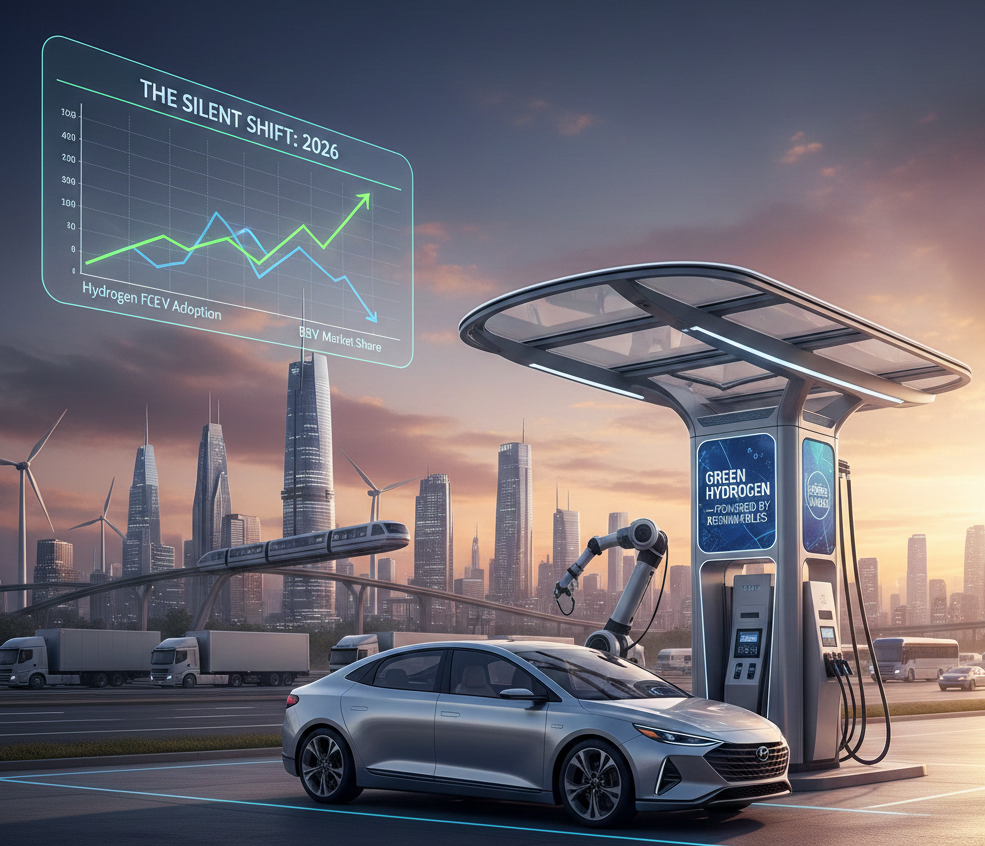
Hydrogen vs. Battery Electric Vehicles (BEVs) is the automotive world’s version of the “Betamax vs. VHS” format war. While batteries have a massive head start, hydrogen proponents argue that the fuel cell’s long-game advantages—refueling speed and weight—will eventually make it the superior choice for a global scale-up.
For the last decade, the narrative of the “green revolution” has been written by lithium-ion batteries. From sleek sedans to high-performance SUVs, battery electric vehicles (BEVs) have enjoyed the spotlight. But as we move into 2026, the cracks in the battery-only strategy are beginning to show. From “range anxiety” to the environmental toll of rare-earth mining, the world is looking for a more sustainable, scalable successor.
Enter the Hydrogen Fuel Cell Electric Vehicle (FCEV)—the technology that doesn’t just promise to supplement batteries, but to eventually replace them as the gold standard for clean transport.
1. The Death of “Range Anxiety”
The Achilles’ heel of the battery car has always been the clock. Even with “ultra-fast” charging, a BEV requires 20 to 45 minutes to reach 80% capacity. In a world built on efficiency, that’s a lifetime.
Hydrogen cars like the 2026 Hyundai Nexo or the Toyota Mirai can be refilled in three to five minutes. This mirrors the gas-station experience consumers have spent a century mastering. For long-distance travelers, fleet operators, and those living in apartments without home charging, hydrogen provides a seamless transition that batteries simply cannot match.
2. Weight and the “Payload Paradox”
Batteries are heavy. To get more range out of a BEV, you need a larger battery, which adds more weight, which in turn requires more energy to move. This “diminishing returns” cycle is why battery-powered semi-trucks and heavy-duty vehicles struggle with cargo capacity.
Hydrogen is the most energy-dense element in the universe. A fuel cell system is significantly lighter than a 1,000-lb battery pack. This weight advantage allows for:
- Better performance: Quicker handling and less wear on tires and roads.
- Greater efficiency for heavy loads: Making it the undisputed king for trucks, buses, and eventually, passenger SUVs.
3. Sustainability Beyond the Tailpipe
While BEVs emit no CO2 while driving, their “cradle-to-grave” impact is under increasing scrutiny. The mining of lithium, cobalt, and nickel is water-intensive and often takes place in ecologically sensitive areas.
Hydrogen production is evolving rapidly. While much of today’s hydrogen comes from natural gas, the surge in Green Hydrogen—produced via electrolysis using wind and solar power—is turning the tide. Furthermore, fuel cells require far fewer rare-earth minerals than massive battery packs, offering a path to a truly circular economy.
4. Grid Stability and Global Adoption
If every car on the road today were a BEV, our current electrical grids would likely collapse under the peak-time demand. Hydrogen acts as a form of energy storage. We can produce hydrogen using excess renewable energy during the day and store it for use whenever needed, acting as a buffer for the grid rather than a drain.
5. The Maintenance Edge: Simplicity vs. Longevity
One of the most compelling arguments for the shift to hydrogen is the long-term maintenance profile. While both BEVs and hydrogen FCEVs benefit from having significantly fewer moving parts than a traditional gas engine (no oil changes, no spark plugs, no timing belts), hydrogen cars offer a unique balance of durability and predictability.
The “Tire Tax” and Weight
Because battery electric vehicles are exceptionally heavy—often weighing 20% to 30% more than a comparable hydrogen or gas vehicle—they tend to go through tires at a much faster rate. For a fleet operator or a high-mileage commuter, the “tire tax” of a BEV can add thousands to the total cost of ownership. Hydrogen vehicles, being lighter, return to a more traditional tire replacement cycle.
Component Comparison: Hydrogen vs. Battery
While BEVs are lauded for their simplicity, they face a looming “cliff” at the end of their battery life. Hydrogen systems take a different approach:
| Feature | Battery Electric (BEV) | Hydrogen Fuel Cell (FCEV) |
| Brakes | Low wear (Regenerative) | Low wear (Regenerative) |
| Cooling Systems | Critical for battery life; periodic flushes | Essential for fuel cell stack; similar to ICE |
| Primary Wear Item | Battery Capacity (Chemical degradation) | Fuel Cell Stack (Operational hours) |
| Tire Longevity | Shorter (Due to extreme weight) | Standard (Similar to gas cars) |
| Refueling/Charging Hardware | High (Battery degradation from fast-charging) | Low (Mechanical tanks last 15+ years) |

The “Degradation” Factor
The most significant maintenance win for hydrogen is how it handles age. Lithium-ion batteries degrade with every charge cycle, particularly when using fast-charging stations. By year 10, a BEV may have lost 10-20% of its range.
In contrast, a hydrogen fuel cell stack is designed for a target lifespan of 150,000 to 200,000 miles with minimal range loss. When the fuel cell does eventually reach its end-of-life, the hydrogen tanks themselves remain perfectly functional and safe, whereas a dead battery pack represents a massive, expensive, and difficult-to-recycle waste product.
Hydrogen energy is often hailed as the “fuel of the future,” but it isn’t a magic bullet. While it burns clean, the infrastructure and physics behind it present some significant hurdles.
Here is a breakdown of the primary drawbacks of hydrogen energy.
1. High Production Costs
Currently, hydrogen is expensive to produce, especially Green Hydrogen (made using renewable electricity).
- The Price Gap: It is significantly more expensive than natural gas or even coal-based energy.
- Energy Intensive: The process of electrolysis—splitting water into hydrogen and oxygen—requires massive amounts of electricity. If that electricity isn’t cheap and renewable, the whole process loses its economic and environmental luster.
2. Infrastructure & Storage Challenges
Hydrogen is the lightest element in the universe, which makes it a nightmare to store and transport.
- Low Volumetric Energy Density: Hydrogen takes up a lot of space. To store it effectively, it must be compressed to extremely high pressures (up to 700 bar) or liquefied at cryogenic temperatures (-253°C).
- Brittle Pipelines: Hydrogen can cause “hydrogen embrittlement,” making standard metal pipes brittle and prone to cracking. We can’t just pump it through existing natural gas lines without significant upgrades.
3. Energy Efficiency Losses
There is a “round-trip” efficiency problem. Every time you convert energy from one form to another, you lose some of it.
- Efficiency Chain: You lose energy during electrolysis, then more during compression/liquefaction, and even more when the fuel cell converts it back into electricity.
- The Math: By the time the energy reaches the wheels of a car, you might only be using 30–35% of the initial renewable energy, compared to 70–90% efficiency in battery electric vehicles (BEVs).
4. The “Green” Paradox
Not all hydrogen is clean. In fact, most hydrogen produced today is Grey Hydrogen, created from natural gas through a process called Steam Methane Reforming (SMR).
- Carbon Footprint: This process releases significant amounts of $CO_2$.
- Methane Leaks: The supply chain for the natural gas used can lead to methane leaks, which are far more potent as a greenhouse gas than carbon dioxide.
5. Safety Concerns
While every fuel has risks, hydrogen has unique properties that require specialized handling:
- High Flammability: It has a wide range of explosive concentrations in air.
- Invisible Flames: Hydrogen burns with a nearly invisible flame, making leaks that have ignited very difficult to detect without specialized equipment.
- Easy Leaks: Because the molecules are so tiny, they can escape through the smallest seals or joinery.
Comparison: Green vs. Blue vs. Grey Hydrogen
| Type | Source | Carbon Footprint | Cost |
| Green | Water + Renewables | Zero | Very High |
| Blue | Natural Gas + Carbon Capture | Low | Moderate |
| Grey | Natural Gas | High | Low |
The Bottom Line
While hydrogen fuel is currently more expensive than electricity at the “pump,” the long-term maintenance savings—driven by reduced tire wear and the lack of a degrading $15,000 battery pack—position hydrogen as the more financially sustainable choice for the second decade of a vehicle’s life. As we transition from “early adoption” to “long-term infrastructure,” the durability of hydrogen will be the key that unlocks mass-market dominance
The Verdict
The transition won’t happen overnight. Infrastructure is still the primary hurdle, with hydrogen stations currently concentrated in specific hubs like California, Germany, and China. However, as governments pivot toward “Hydrogen Hubs” and manufacturers like BMW and Honda double down on fuel cell tech, the momentum is shifting.
Batteries may have won the first round, but in the marathon to decarbonize the planet, hydrogen’s versatility, speed, and scalability make it the inevitable winner.
The hydrogen generator (often called an HHO or Oxy-hydrogen kit)
Adding hydrogen generators to the current global fleet would be particularly effective because it targets diesel engines, which are the primary source of soot (black carbon). While CO2 is the “marathon” of climate change, soot is the “sprint”—it’s a super-pollutant that warms the air hundreds of times more effectively than CO2 but only stays in the air for a few weeks.
By installing these generators, we essentially change the “thermal profile” of the next two decades. Here is how that affects the timeline:
1. The Diesel vs. Gasoline Impact
The “soot factor” is vastly different depending on what fuel the car burns. Hydrogen acts as a powerful cleaner for both, but the climate results differ:
- Diesel (Heavy Impact): Diesel engines are the “soot factories” of the world. Research shows that adding a small amount of hydrogen (HHO) can reduce soot and particulate matter by 30% to 85%.
- Climate Result: Because soot is a “short-lived climate forcer,” cutting it by 80% globally would cause an almost immediate cooling effect in the atmosphere, potentially lowering the global temperature by a fraction of a degree within just a few years.
- Gasoline (Efficiency Impact): Gasoline engines produce much less soot but are less efficient. Hydrogen injection here primarily targets Carbon Monoxide (CO) and Unburned Hydrocarbons (HC), reducing them by 50% to 80%.
- Climate Result: This improves air quality in cities immediately and reduces the “precursor” gases that create ozone (another greenhouse gas).
2. Shifting the “Tipping Point” Timeline
If we retrofitted all existing cars with hydrogen generators by 2030, we could potentially push back major climate “tipping points” (like the total loss of Arctic summer ice) by 10 to 15 years.
- The “Arctic Brake”: Soot is the primary reason the Arctic is melting four times faster than the rest of the planet. When soot lands on ice, it turns the ice dark, causing it to absorb heat. Universal hydrogen enrichment would drastically reduce the “darkening” of the poles, preserving the Earth’s natural “mirror” (the albedo effect).
- A Safety Buffer for EVs: Right now, we are in a race to build enough electric cars. However, every year we wait, the old diesel trucks still on the road are dumping soot that causes permanent damage. Hydrogen generators provide a “Holding Pattern”—they mitigate the damage of the existing fleet while the new electric fleet is being built.
3. Summary of Potential Timeline Gains
| Targeted Pollutant | Effect of H2 Injection | Time to see Climate Impact | Timeline Gain |
| Soot (Black Carbon) | 30% – 85% Reduction | 2 – 4 Weeks | Delay Arctic melt by ~10 years |
| Carbon Dioxide (CO2) | 10% – 20% Reduction | 50+ Years | Slight reduction in “Peak Heat” |
| Nitrogen Oxides (NOx) | Mixed (Can increase or decrease) | 1 – 2 Years | Improved regional air quality |
The “Trade-off” Note
One important scientific catch: Because hydrogen makes the engine burn hotter, it can sometimes increase Nitrogen Oxide (NOx) emissions by 10-15% if not properly tuned. While NOx isn’t the primary driver of the “soot timeline,” it does cause smog and respiratory issues.